THE COLLECTED WORKS

Sri Ramana Maharshi 

Sri Ramana Maharshi

The Collected Works

Vivekachudamani

‘Though various obstacles contribute to the bondage of the soul, the primary cause of them all is the rising of the false ego-sense. It is through the superimposition of the ego on the Self that this bondage of birth, death and sorrow has come upon you who are by nature Being-Consciousness-Bliss, of boundless glory, eternal, single in essence, unchanging. By nature you have no such bondage…’

MAHAVATAR Babaji for advaita, vedanta and Ramana

QUOTES FROM THE VOICE OF BABAJI
  • ‘‘Ulladu Narpadu’ is a poem of forty verses on the nature of Existence. The Tamil ulladu, like the Sanskrit sat means what exists or existence and reality. Existence and reality are the same in Vedanta. As the Bhagavad Gita puts it, “of the unreal there is existence, of the real there is no non-existence.” ‘

  • ‘The truth is that Existence alone is real, the body, the house etc., being appearances thereof.’

  • ‘When the Vedanta speaks of Existence as reality, it does not mean brute existence. It is intelligence and bliss, sacchidananda. It is this Existence-Intelligence-Bliss, that is, non-dual Absolute, the one only without a second. All distinctions such as “I” and “Thou” are but appearances. The Self alone is.’

  • ‘The non-duality of the Absolute, the non-reality of the world, and the non-difference of the so called individual soul from the absolute Reality constitutes the truth of advaita. Sri Ramana Maharshi’s ‘Ulladu Narpadu’ is an authentic exposition of the advaita experience.’

  • ‘We believe that advaita is not a sacred doctrine. It is the culmination of all doctrines, the crown of all views. Even though, other views may imagine themselves opposed to advaita. Advaita is opposed to none.’

  • ‘When the whole truth is realized, there can be not hostility. That is exactly the teaching of Sri Ramana Maharshi. Through the medium of these forty verses, the sage of Arunachala transmits to us the plenary experience, which is that of advaita.’

  • ‘ If one understands even theoretically the path pointed out by the sage of Arunachala, he cannot but become fearless and self-reliant. He would not lean on any external agency to vouchsafe him with his salvation. He has to work it out himself. He ceases to worry himself about his probable abode in hell or heaven, as depicted by some religions. Through deep regular meditation and firm abidance in his immortal Self, he sheds all doubts and forebodings about his future life.’


the Book

THE COLLECTED WORKS

by Sri Ramana Maharshi

The Book

The Collected Works

Quotes: the collected works

<< Slider >>

“11. If this is the nature of liberation (moksha) why do some scriptures connect it with the body and say that the individual soul can attain liberation only when it does not leave the body?

It is only if bondage is real that liberation and the nature of its experiences have to be considered. So far as the Self (Purusha) is concerned it has really no bondage in any of the four states. As bondage is merely a verbal assumption according to the emphatic proclamation of the Vedanta system, how can the question of liberation, which depends upon the question of bondage, arise when there is no bondage?”

“12. If that is so, do not the descriptions of bondage and release
found in the scriptures become irrelevant and untrue?

No, they do not. On the contrary, the delusion of bondage
fabricated by ignorance from time immemorial can be
removed only by knowledge, and for this purpose the term ‘liberation’ (mukti) has been usually accepted. That is all. The fact that the characteristics of liberation are described in different ways proves that they are imaginary.”

13. If that is so, are not all efforts such as study (lit., hearing)
reflection, etc., useless?

No, they are not. The firm conviction that there is neither
bondage nor liberation is the supreme purpose of all efforts. As this purpose of seeing boldly, through direct experience, that bondage and liberation do not exist, cannot be achieved except with the aid of the aforesaid practices, these efforts are useful.

14. Is there any authority for saying that there is neither
bondage nor liberation?

This is decided on the strength of experience and not merely
on the strength of the scriptures.

16. If truly there is neither bondage nor liberation what is the reason for the actual experience of joys and sorrows?

They appear to be real only when one turns aside from one’s real nature. They do not really exist.

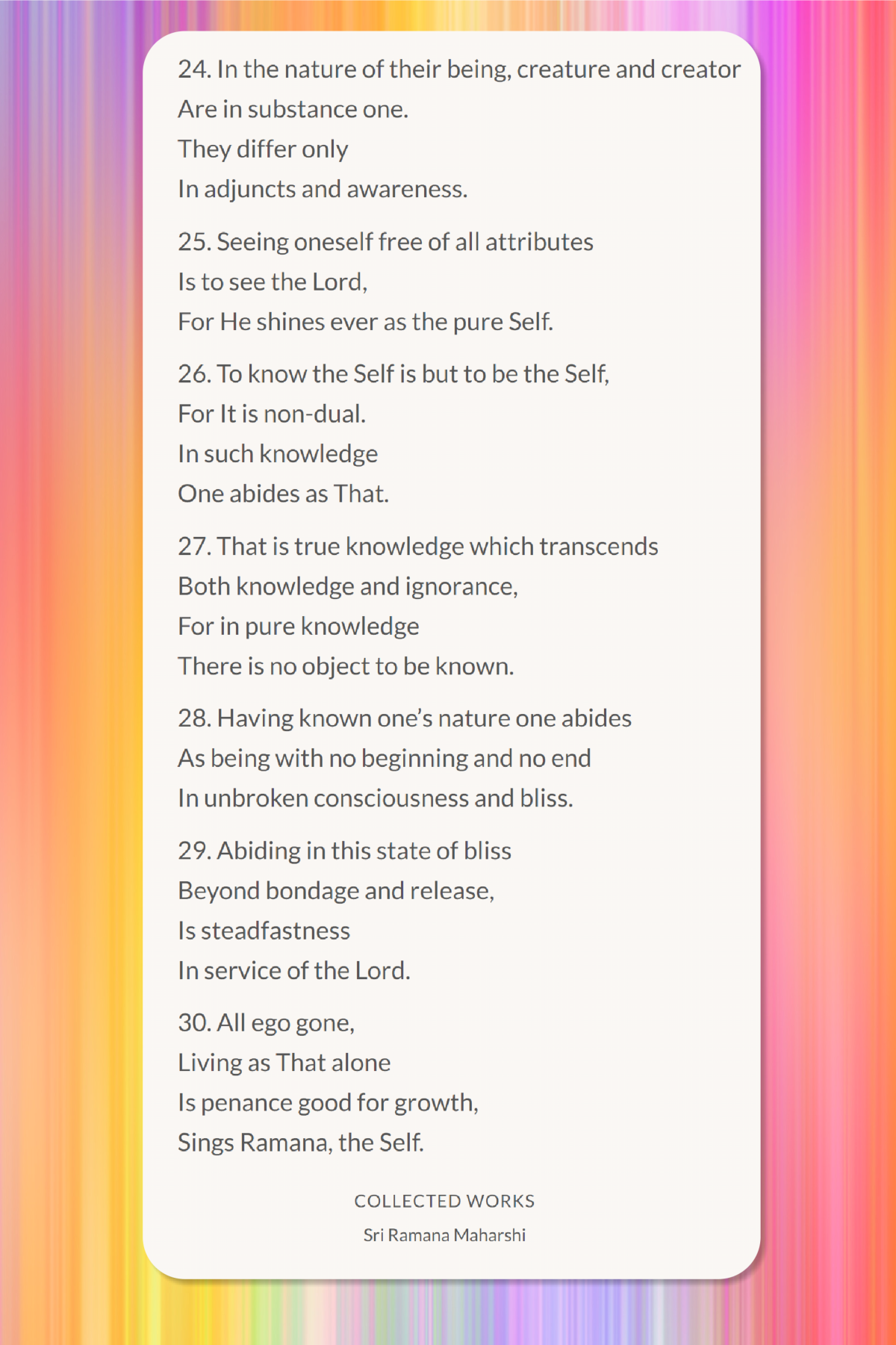
24. In the nature of their being, creature and creator
Are in substance one.
They differ only
In adjuncts and awareness.

25. Seeing oneself free of all attributes
Is to see the Lord,
For He shines ever as the pure Self.

26. To know the Self is but to be the Self,
For It is non-dual.
In such knowledge
One abides as That.

27. That is true knowledge which transcends
Both knowledge and ignorance,
For in pure knowledge
There is no object to be known.

28. Having known one’s nature one abides
As being with no beginning and no end
In unbroken consciousness and bliss.

29. Abiding in this state of bliss
Beyond bondage and release,
Is steadfastness
In service of the Lord.

30. All ego gone,
Living as That alone
Is penance good for growth,
Sings Ramana, the Self.


M: The jiva itself is Siva; Siva Himself is the jiva. It is true that the jiva is no other than Siva. When the grain is hidden inside the husk, it is called paddy; when it is dehusked, it is called rice. Similarly, so long as one is bound by karma one remains a jiva; when the bond of ignorance is broken, one shines as Siva, the Deity. Thus declares a scriptural text. Accordingly, the jiva which is mind, is in reality the pure Self; but, forgetting this truth, it imagines itself to be an individual soul and gets bound in the shape of mind. So its search for the Self, which is itself, is like the search for the sheep by the shepherd. But still, the jiva which has forgotten itself will not become the Self through mere mediate knowledge. By the impediment caused by the residual impressions gathered in previous births, the jiva forgets again and again its identity with the Self and gets deceived, identifying itself with the body, etc. Will a person become a high officer by merely looking at him? Is it not by steady effort in that direction that he could become a highly placed officer? Similarly, the jiva, which is in bondage through mental identification with the body, etc., should put forth effort in the form of reflection on the Self in a gradual and sustained manner; and when thus the mind gets destroyed, the jiva would become the Self.
The reflection on the Self which is thus practised constantly will destroy the mind, and thereafter will destroy itself like the stick that is used to kindle the cinders burning a corpse. It is this state that is called release.


9. Is it possible to overcome, even while the body exists, the karma (prarabdha) which is said to last till the end of the body?

Yes. If the agent (doer) upon whom the karma depends, namely the ego, which has come into existence between the body and the Self, merges in its source and loses its form, will the karma which depends upon it alone survive?
Therefore when there is no ‘I’ there is no karma.


quotes

read the book online

Read the book online:

Quotes

’19. Unite with that one totality, which is all-pervasive, which has no inside or outside, which is bereft of all (concept of) directions such as above, below and in between, which assumes all the forms in creation and yet is itself formless, which can be known only by itself, and which is self-luminous.
20. People perform their actions having their own aims in mind, and they accordingly reap the consequences of their actions by attaining those aims. Therefore do not engage in such actions which are not free from flaws (leading to bondage). Turn the attention completely away from external objects and concentrate only upon that (the Self) which cannot be seen.
21. In our natural state, actions, cause and result of such actions, and all the various other theories propounded (in the scriptures) do not exist. In fact, even the diverse world does not exist. As such even the worldly individual who is attached to (the various attractions of) the world is also nonexistent.’

/ The Collected Works, Devikalottara/

Video

quotes - vivekachudamani

Vivekachudamani

1. It is indeed very difficult to obtain a human body.

Vivekachudamani
 
Vivekachudamani


2. Even though one does, it is very difficult to become a brahmin.

Vivekachudamani
Vivekachudamani


3. Even if one becomes one, it is still more difficult to walk in the path of vaidika dharma in which the Vedas are chanted.

Vivekachudamani
Vivekachudamani


4. Still more difficult is it to become a perfect scholar, and more
difficult again to undertake enquiry into the Self and the non-Self.

Vivekachudamani
Vivekachudamani

5. IYet more difficult than all this is to obtain wisdom born of experience of the Self

 Liberation in the form of
abidance as the Self, born of that wisdom, is not to be attained
except as a result of righteous actions performed throughout
countless crores of births.
 
Vivekachudamani


6.

However, even though all the above
qualifications may not be obtained, liberation is assured
through the grace of the Lord if only three conditions are
obtained: that is a human birth, intense desire for liberation,
and association with sages.

Latest posts